
The Factory Series, Paper 3 · The future belongs to those who architect ideas — not just generate outputs. Here’s how to prove you’re the former.
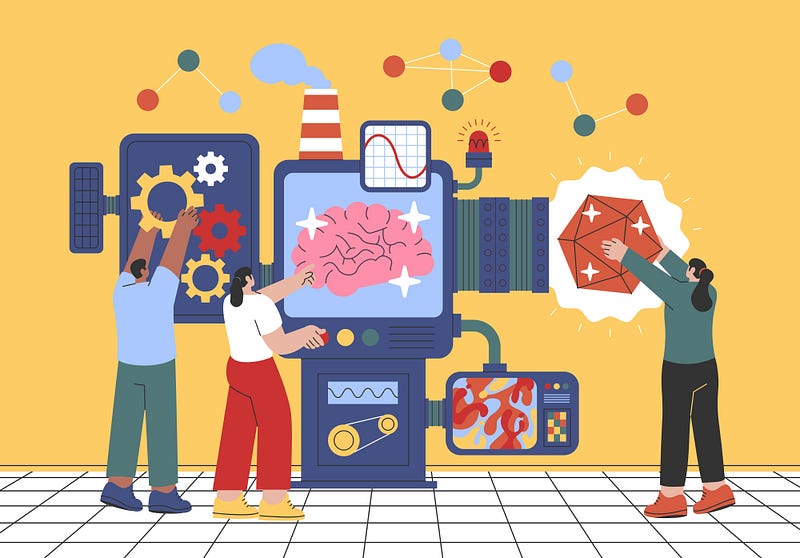
The New Creative Class — Authorship is no longer claimed. It is proven.
There are two types of people using AI right now.
One group enters with a blueprint — a question, a framework, a standard they hold throughout. The other hands the machine a vague prompt and calls the output their ideas.
The difference between them isn’t visible in the output. It’s visible in what they brought before the output existed.
Every Shift Creates Something New
The novel did not kill the play.
The film did not kill the novel.
The album did not kill the concert.
The podcast did not kill the radio.
Every major technological shift in creative production generated panic, backlash, legal contestation — and eventually a new creative role that had not previously existed. Not a replacement. An addition. A new kind of maker who understood the new instrument natively and built something the previous generation could not have imagined.
The film director did not exist before cinema. The record producer did not exist before recorded sound. The sampling artist did not exist before the drum machine and the turntable. Each emerged from a period of disruption that looked, from inside it, like destruction.
We are inside that period now.
The question is not whether AI will replace human creativity. It will not — for reasons this series has been building toward from the first paper. The question is what new creative role is emerging, what discipline it requires, and who will actually qualify.
The New Architect
They are already here.
Not the person who prompts an AI and publishes the output. Not the person who asks a chatbot to write their essay and puts their name on it. Those are not new creators. They are the latest iteration of the person who always existed — the one who mistakes assembly for architecture.
The new creative class is something different.
They are human architects who treat AI as a native instrument — the way the film director treats the camera, the way the record producer treats the mixing board, the way the fashion designer treats the atelier. The instrument is not the work. The instrument executes the work. The architect conceives it, directs it, evaluates it, and stands accountable for it.
What makes them new is not the tool. It is the scale at which a single human architect can now operate. One person with disciplined AI fluency can produce at volumes that previously required studios, publishing houses, or production companies. One researcher with a formal methodology can build a cross-domain diagnostic framework in five months that previously would have required a team and a decade.
But scale without structure is not the new creative class. It is Phase Drift at industrial volumes.
The new creative class is defined by one thing above all others: they can prove they were the architect.
The Invisible Seam Problem in Writing
Paper 2 established that the factory has always existed — ateliers, ghost writers, film crews, fashion houses, professional kitchens, sampling culture. In every previous domain, the seam between architect and assembly was visible in some form: film credits, licensing records, atelier hierarchies, ghost writer contracts. The production chain left a trail.
Writing is different.
In writing, the contribution is the words. There is no separate production chain to examine, no credits to consult, no licensing trail to follow. When a named author publishes an essay, the implicit claim is not merely “I directed this.” It is “I wrote this.” And in law, in academic convention, and in reader expectation, those are not the same claim.
AI makes the seam in writing uniquely difficult to locate — and the detection tools being deployed to find it reveal exactly why.
Software like Turnitin, GPTZero, and Copyleaks operates on statistical pattern recognition. These tools identify writing that matches the probability distributions characteristic of large language model output — certain sentence length patterns, vocabulary distributions, syntactic regularities, low perplexity scores. They do not detect AI. They detect writing that statistically resembles AI output. The distinction matters. A human writer with a regular, clear, low-variance style will trigger false positives. A Level 1 essay substantially revised by its human author will often evade detection entirely.
Readers who claim they can identify AI writing are often correct — about careless Level 4 output. The patterns they recognize are real: generic transitions, hedged conclusions that resolve nothing, examples that feel statistically plausible rather than lived, a frictionless fluency that never catches on anything specific or surprising. These are genuine signals of Phase Drift — uncoordinated assembly, not AI per se. The same readers cannot reliably distinguish disciplined AI-assisted writing from unassisted writing. Detection catches the careless, not the disciplined.
Images are a genuinely different case. AI image generation has characteristic artifacts — texture failures, hand rendering errors, background incoherence, lighting inconsistencies — that trained eyes increasingly recognize. Writing has no equivalent artifact layer. The gap between visual and textual detection is significant and frequently misunderstood.
What no detection tool addresses — what no reader intuition can access — is provenance. Detection tools measure pattern. They cannot measure where the intelligence originated. A Level 1 essay and a Level 4 essay may produce identical detection scores while representing categorically different relationships between human and machine. The instrument looks at the output. Provenance is in the process.
This is the sharpest challenge the new creative class faces — and it is unique to writing. The film director has the set. The fashion designer has the atelier. The AI-assisted writer has only the output.
Unless they have something else entirely.
The Authorship Spectrum
The question “did AI write it?” is the wrong question. It is a binary that does not map onto the reality of how AI-assisted work is actually produced.
The right question is: where did the intelligence originate?
And the answer exists on a spectrum.
Level 1 — Originating Intelligence
The human contributes the question, the framework, the evaluative standard, and the through-line before the AI session begins. The concept exists in the human’s mind — however roughly — and is expressed in some form before AI touches it. AI then functions as an analytical instrument: exploring, amplifying, stress-testing, connecting, assembling. The human evaluates every output against an internal standard that pre-exists the session. The human revises, rejects, selects, and holds accountability for the final claim.
The human contribution here is the originating question, the conceptual framework, the evaluative criteria, the through-line across sessions, the selection and rejection of AI output, and the final accountability. The AI contribution is scalar assembly of expression — faster, broader, more exhaustive than the human alone, but always operating downstream of the human’s originating intelligence.
Level 2 — Directed Assembly
The human contributes a detailed brief — structure, argument, evidence, voice direction. AI assembles prose from the brief. The human reviews and revises substantially. The ideas are the human’s. The assembly is the AI’s.
Level 3 — Skilled Curation
The human contributes prompt design and selection judgment. AI generates ideas, connections, structure, and prose simultaneously. The human selects, sequences, and refines. Curation is a real skill, but it is categorically different from origination.
Level 4 — Prompted Retrieval
The human provides a topic. AI generates everything — the idea, the argument, the connections, and the prose. The human publishes it. There is no human creative contribution that copyright law, academic convention, or honest reader expectation would recognize as authorship. This is retrieval dressed as creation.
All four levels produce prose that looks identical to the reader — and may produce identical scores on detection software. The fluency is the same. The formatting is the same. The apparent coherence is the same. A Level 1 essay and a Level 4 essay are indistinguishable at the surface. Detection tools that measure statistical pattern cannot distinguish them. Reader intuition that recognizes Phase Drift patterns cannot distinguish them when the Level 1 author has maintained coordination throughout.
This is Phase Drift at the level of authorship itself. Output continues. The coordination between claimed authorship and actual origination quietly collapses. No scalar measure catches it. No detection tool reaches it.
The only thing that distinguishes Level 1 from Level 4 is the documented process — or its absence.
Originating Intelligence
The concept that resolves the binary is not “did a human write it?” It is “did a human originate it?”
Originating Intelligence is the human contribution that pre-exists the AI session: the question, the framework, the evaluative standard, the felt sense of what the work is trying to do. It is the blueprint the architect brings to the factory before the machines begin. It is what the master brought to the atelier each morning. It is what the director holds across years of production that no crew member can substitute for.
Originating Intelligence is categorically different from directing assembly after the AI has already generated the ideas. It is the condition that makes Level 1 work genuinely authored — and its absence is what makes Level 4 work retrieval rather than creation.
For the Tang Papers, Originating Intelligence is not a claim — it is a documented condition. The phenomenological question that initiated the program arose from lived experience: the direct observation of how AI systems produce coherent-sounding output while failing to coordinate meaningfully across claims. That observation preceded every AI session. The frameworks that emerged — Phase Drift, the Scalar-Phase distinction, PSR, HAICR — were developed through sustained inquiry in which the human was always ahead of the AI, pulling it toward a destination the AI could not have generated independently.
The AI then serves that originating intelligence, not the reverse.
The Tang Papers are structured to operate at Level 1, with documentation intended to demonstrate it. The documentation is public, versioned, and persistent.
The Burden of Proof
In the age of the invisible seam, the writer’s burden has changed.
It is no longer sufficient to produce fluent prose. Fluency is now the cheapest commodity in the history of human communication. AI produces fluency at volumes and speeds that no human writer can match, at a cost approaching zero.
What is scarce — genuinely, structurally scarce — is documented originating intelligence.
The film director has the production record. The fashion designer has the atelier archive. The ghost-written memoir has the contract. Writing under AI assistance has none of these established frameworks.
What it has — for now — is the Project Archive.
The Project Archive is the documented record that makes the invisible seam visible. But there are two layers, and the distinction matters.
The Output Archive is what most researchers maintain — the published papers, the versioned Zenodo records, the timestamped DOIs. For the Tang Papers this means fourteen papers, versioned and dated, showing the development of frameworks across five months under named authorship with persistent identifiers and ORCID attribution. It is essential. It is not sufficient on its own.
The Process Archive is what distinguishes the new creative class. It is the dialogue record — the conversation threads across platforms that show the originating intelligence in motion: the questions asked before the answers emerged, the frameworks stress-tested and sometimes rejected, the iterations that led from rough observation to formal framework, the human re-anchoring the AI at the start of each session. For the Tang Papers, this process archive spans three AI platforms — ChatGPT, Claude, and Gemini — each deployed for specific functions, with the human holding the through-line across all of them.
Most AI-assisted researchers keep only the output. The new creative class keeps the process.
The answer to “did you write it?” is not yes or no. It is: here is the process archive — the record of where the intelligence originated, how it developed, and what the human contributed at every stage, documented before, during, and between the published outputs.
The new creative class will be defined by who maintains this record — and who does not.
The Copyright Reality
Copyright law is catching up to this distinction — slowly, imperfectly, but in the direction the authorship spectrum predicts.
The US Copyright Office has been explicit: AI-generated content is not copyrightable. Human creative expression is. The line is not whether AI was used. It is whether sufficient human creative contribution exists in the final output — and whether that contribution can be demonstrated.
This maps directly onto the authorship spectrum. Level 1 work — originating intelligence documented, AI functioning as downstream instrument — is copyrightable. Level 4 work — prompted retrieval with no human creative contribution — is not. Levels 2 and 3 are legally uncertain and practically dependent on documentation.
In Canada, fair dealing provisions protect the analytical use of copyrighted source material for research and commentary — including the practice of applying original diagnostic frameworks to external papers and producing original analytical conclusions. The transformative use is the strongest fair dealing claim available.
But copyright is not the foundation here. It is the pressure test.
The foundation is authorship. And authorship, in the age of the invisible seam, is proved not by the output but by the documented origin of the intelligence that produced it — and by the process archive that shows that intelligence at work.
What the New Creative Class Actually Looks Like
They document before they prompt.
Before any AI session, they articulate — in some form — the question, the framework, or the direction they are bringing to the factory. This articulation does not need to be polished. It needs to exist. It is the blueprint. Without it, there is no architect. There is only a factory running unsupervised.
They hold the through-line across sessions.
AI tools are developing memory — the ability to carry facts and preferences forward. But memory and through-line are not the same thing. Memory accumulates. Through-line coordinates. The new creative class re-anchors the AI at every session because holding the coordinating intent — the evaluative standard, the architectural direction, the judgment about whether accumulated output is converging toward the originating intelligence or drifting away from it — is a judgment function that memory systems do not provide. The Scalar Apprentice is becoming better at remembering. It is not becoming better at knowing what the work is for.
They maintain the Project Archive — both layers.
Every significant piece of work has a documented origin and, beyond that, the dialogue record that shows the originating intelligence at work before and between the published pieces. This is not bureaucratic overhead. It is the visible seam in a domain where the seam is otherwise invisible.
They accept accountability for the claims made.
Their name is on the work. Not as a courtesy. As a commitment. If the framework is wrong, the claim is wrong, the conclusion is wrong — the failure is theirs. Attributable, traceable, correctable.
The Sovereign Architect
The new creative class is not defined by access to AI tools. Everyone has access.
It is not defined by fluency of output. AI produces fluency at industrial scale.
It is not defined by volume of publication. Phase Drift produces volume without coordination.
It is not defined by a clean detection score. Detection tools measure pattern, not provenance.
It is defined by sovereignty — the demonstrated capacity to originate, direct, evaluate, and account for creative work in a domain where the instrument and the output are indistinguishable without documentation.
Sovereignty requires a Project Archive — both the output record and the process record. It requires a through-line. It requires originating intelligence that pre-exists the AI session. It requires a name on the work and accountability for what that name claims.
The backlash against AI-assisted creation will follow the same arc as every previous disruption — contestation, framework development, normalization, new creative form. What emerges on the other side will not be a world without AI assembly. It will be a world that has learned to distinguish the sovereign architect from the prompter with a byline.
That distinction will not be made by examining the output. The output is indistinguishable. Detection tools cannot make it. Reader intuition cannot reliably make it.
It will be made by examining the archive.
The Question That Remains
Paper 1 asked: what is the difference between assembly and architecture?
Paper 2 answered: the factory was always there — the difference was always the architect.
Paper 3 asks the harder question: in a world where the seam is invisible and detection tools measure pattern rather than provenance, how do you prove you were the architect?
The answer is not philosophical. It is practical.
You prove it the way every previous creative tradition has proved it — through the documented record of the originating intelligence that preceded the assembly. Not just the output archive. The process archive. The dialogue record that shows the intelligence at work before the finished pieces existed.
The director has the production archive. The fashion designer has the atelier record. The ghost writer has the contract. The Tang Papers researcher has the Zenodo DOIs, the ORCID, the HAICR methodology, the versioned sequence of fourteen papers across five months — and the cross-platform dialogue record that shows the originating intelligence developing in real time, held together by the human through-line that no AI tool could have maintained across three core platforms and five months of inquiry.
The new creative class will build their own archives.
Or they will not be the new creative class. They will be the factory running without an architect.
And the factory, as this series has established from the first paper, has always been there.
The only question that has ever mattered is who was holding the blueprint.
Core Insight Authorship is no longer about who typed the words. It is about who originated the intelligence — and whether they can prove it. Detection tools measure pattern. Provenance is in the process archive.
What to do differently tomorrow Before your next AI session: articulate your originating intelligence first. Write down — in any form — the question, the framework, or the direction you are bringing to the factory. Then keep the dialogue. The process archive is the visible seam. Without it, you have output. With it, you have provenance.
Previous in this series: → The Factory Has Always Existed — AI Just Made It Visible
Next in this series: → How the Tang Papers Were Actually Built — the phenomenological account of originating intelligence across five months and four AI platforms.
Full open-access research archive: 👉 dancescape.com/research
— Lit Meng (Robert) Tang Independent researcher, Tang Papers program