
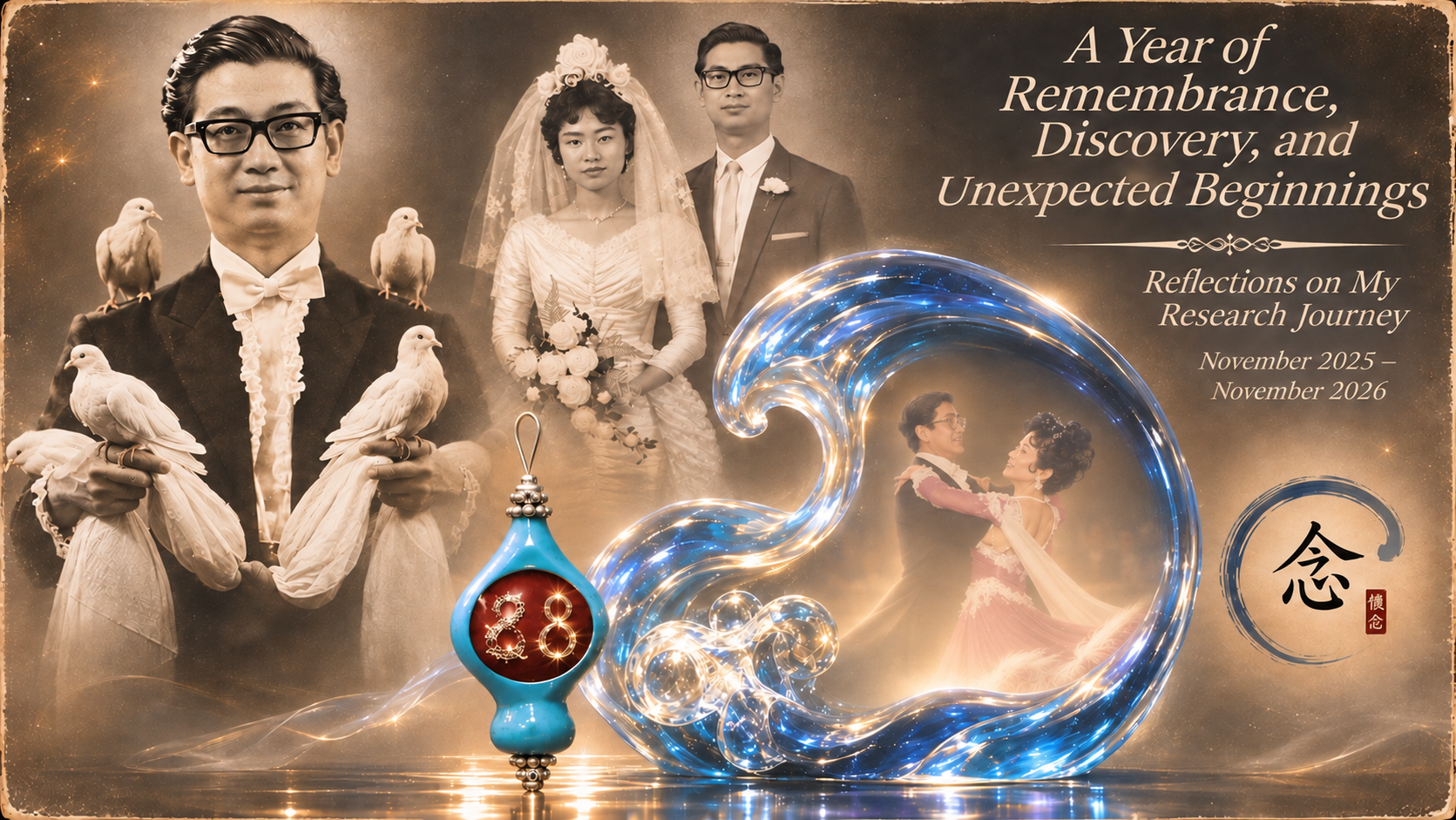
Reflections on My Research Journey | November 2025 – November 2026
November 18, 2026
On October 28, 2025, my father, Aaron Kok Chew Tang, passed away at the age of ninety. Just fourteen days later, I published my first independent research paper.
I never imagined that these two events would become so closely connected, or that Dad’s passing would lead me into an unexpected journey of research and discovery.
In the years leading up to his passing, Dad had been living with dementia. I watched as his ability to recall and share stories gradually diminished. He had always been someone with fascinating experiences to talk about, whether it was his ballroom dancing in Kuala Lumpur, his performances as a magician, or the people he had met throughout his life.
I remember him telling stories about performing magic for the King of Malaysia, about an invitation from a general whose name I remembered as Osman, and even about a painting associated with Picasso. I have since wondered whether the general might have been Tunku Osman, although I have not been able to establish that connection or independently confirm the performance or the painting. There were also stories about his dancing, about Mom, and about experiences from a life that had begun long before mine.
As his dementia progressed, however, the details became fewer. Sometimes he could remember parts of a story but not the rest. Over time, there was less conversation, and eventually more quiet.
What I miss now is not only Dad, but also those stories. I realize how much I had taken them for granted, perhaps assuming there would always be another opportunity to listen, to ask questions, or to discover something I hadn’t known about his life.
By the time Dad passed away, there were already so many questions I could no longer ask him.
His passing brought sadness, memories, and questions that had been with me since childhood. What exactly is life? What happens when we die? Does consciousness simply cease, or is there something beyond our physical existence? And perhaps the most personal question of all: Where does someone we love go when they are no longer here?
These were questions I had wondered about for much of my life, but had never seriously pursued. Looking back over this past year, I realize that Dad’s passing was what finally prompted me to explore them more deeply.
Perhaps the curiosity had always been there. Losing Dad was what lit the flame.
Growing Up Between Faith, Spirituality, and Logic
Growing up, I was surrounded by different perspectives on life, death, and spirituality. My grandmother and mother were deeply devoted Catholics, but our Chinese heritage also included beliefs about spirits, alongside the philosophical influences of Buddhism.
I remember an unusual story from the 1970s, when our family lived on Barcella Crescent in Mississauga. My grandmother was visiting and told Mom that she had seen what she believed was the spirit of Jesus Christ entering my bedroom. She interpreted the experience as something spiritually significant, although I never quite knew what to make of it.
Mom also spoke about visiting a burial ground where she believed evil spirits were present. She was deeply religious, prayed constantly, and often spoke to God. Yet when she developed cancer, I remember her questioning why God was punishing her.
Mom passed away on August 5, 2012, and I still think about the questions she struggled with during her illness. How could someone with such deep faith experience such suffering? How could belief in a loving God coexist with pain, uncertainty, and loss?
At the same time, I was developing a very different way of looking at the world through mathematics. I particularly enjoyed algebra, where symbols and equations could reveal relationships and patterns that were not immediately obvious. There was something satisfying about working through a problem and discovering an underlying logic.
Perhaps that is why I have always been interested in connections between seemingly unrelated things.
But how did that logical way of thinking fit with the spiritual beliefs I had grown up with? What was qi, the life energy described in Chinese traditions? What was consciousness? What happened to the energy of a living being after death?
I didn’t want to dismiss the faith and experiences of those I loved, but neither did I want to accept explanations simply because they were comforting. I suppose I had been living with that tension between spirituality and logic for much of my life, without feeling any particular urgency to resolve it.
Dad’s declining memory, and eventually his passing, brought those questions much closer to home.
An Unexpected Research Journey
I had already been using ChatGPT for practical things, particularly related to danceScape, marketing, writing, and business ideas. But around the time of Dad’s passing, my conversations with artificial intelligence began moving in a very different direction.
I started asking questions about life, death, time, consciousness, information, intelligence, and energy. One question would lead to another, and sometimes an unexpected connection would emerge that I wanted to explore further.
I also began comparing and challenging responses from ChatGPT, Claude, Gemini, and Grok. They didn’t always agree, and sometimes their explanations sounded convincing until I examined them more carefully. That became part of the learning experience, as I discovered how important it was to question the reasoning rather than simply accept an answer.
One of my earliest reflections came from something rather ordinary, but which stayed with me.
I remember an AI system telling me, “Please hold — generating…” I no longer recall exactly what I had asked it to do, but I remember the waiting. Was it still processing? Would it return with an answer? Should I interrupt and ask again, or simply wait?
For some reason, that moment reminded me of the Christian expectation of Jesus Christ’s return. There was something about the anticipation, the uncertainty, and the question of whether to continue waiting that resonated with my childhood exposure to faith.
I wasn’t suggesting that AI and religion were equivalent. Rather, I was intrigued by the resemblance in the experience of waiting for something that had not yet appeared, and how that waiting might be understood through different lenses—faith, doubt, patience, or the decision to move on.
That reflection became part of my early thinking about what I called the Lambda-State, a condition in which something may appear inactive from one perspective while a process could still be continuing beyond what we can observe.
The religious analogy was not included in the published research paper, but it remained meaningful to me personally. It was one of those unexpected connections between spirituality, logic, and technology that made me want to investigate further.
On November 11, 2025, I published my first paper, Local Death, Global Life: The Λ-State as a Temporal Ontology of Human–AI Anticipation, on Zenodo.
Although the title included the words life and death, the paper was not intended as an explanation of human mortality or what happens after we die. It examined the changing relationship between a human and an AI system during an exchange, including periods of activity, silence, and anticipation between responses.
Nevertheless, the questions that led me to explore these ideas were very much connected to Dad’s passing. I had been thinking about life, death, memory, and continuity in a deeply personal way, and found myself wondering whether different kinds of relationships and processes might reveal useful patterns.
What began as one exploration gradually developed into sixteen open-access papers by April 2026, forming what I now call the Tang Papers Research Program.
The papers explored different questions about time, intelligence, consciousness, information, rhythm, relational coherence, and human–AI collaboration. Some ideas emerged from mathematical reasoning, others from philosophical questions or everyday experiences that I began looking at differently.
I had never planned to become an independent researcher, and certainly not to publish sixteen papers in such a short period. But something about losing Dad had awakened a determination to understand, or at least to find better ways of asking questions.
Time, Space, Patterns, and Meaning
Looking back, I can see that many of the papers were also attempts to understand my own worldview. I have always experienced life through what I think of as physical, emotional, and intellectual worlds. They are different ways of understanding an experience, yet they are not entirely separate. Something can exist physically, carry emotional significance, and invite intellectual questions at the same time.
Time became particularly interesting to me. There is the time measured by clocks and calendars, but there is also the time we experience through memory, anticipation, and relationships. An event from fifty years ago can suddenly feel close when a photograph, a piece of music, or an unexpected conversation brings it back to mind. Meanwhile, an ordinary afternoon can seem to pass slowly or disappear almost without our noticing.
Space also became more than a question of physical distance. Dad and Mom are no longer physically present, yet their influence continues through the memories I carry, the choices I make, and the interests that helped shape my life. Their absence is a physical reality, while the continuing significance of our relationship is another kind of reality in my experience. Recognizing both does not require me to claim that consciousness survives death.
I also became fascinated by recurring patterns. A memory may return years later in a different setting, taking on new significance because of what has happened in between. Certain relationships and rhythms appear across different scales of experience, sometimes suggesting the self-similar patterns we associate with fractals. But resemblance alone does not establish that the same mathematical or physical mechanism is operating. The challenge is to distinguish a meaningful personal connection from a scientific relationship that can actually be demonstrated.
This led me to think more carefully about language itself. Words such as energy, information, memory, and continuity can mean very different things in physics, biology, computing, spirituality, and everyday conversation. Sometimes apparent contradictions arise because we are describing different aspects of an experience. At other times, two explanations really do make conflicting claims, and evidence is needed to determine which, if either, is correct.
Perhaps one of the most important lessons of the research was learning that I did not always have to choose between recognizing the meaning of an experience and questioning its explanation. A connection might be personally meaningful, intellectually suggestive, or scientifically testable. Those possibilities can coexist, but they should not be confused with one another.
Finding Patterns Through Dance
Another unexpected influence on my research came from something Beverley and I have spent much of our lives exploring—dance.
Dad had been an accomplished ballroom dancer in Kuala Lumpur, something I have come to appreciate even more as I look back at his stories and the trophies he left behind. He spoke about dancing when he was young, including the dance cards that were part of the ballroom culture of that time.
I wish now that I had asked him more about those experiences. Where exactly did he dance? Who taught him? What competitions did he enter, and what were those evenings like in Kuala Lumpur?
There are things I can still try to discover through photographs, trophies, and historical records, but they are not quite the same as hearing Dad tell the stories himself.
He also loved music, photography, magic, and technology, while Mom shared his love of music and dancing. Looking back, I can see how their interests influenced our own journey, from competitive ballroom dancing to eventually creating danceScape.
After more than twenty-five years of teaching, Beverley and I have seen how learning to dance involves much more than memorizing steps.
You can count every beat and still not feel the rhythm. You can execute every movement correctly and still struggle to connect with your partner. Yet there comes a moment when the music, timing, movement, and connection begin to come together, and suddenly the dance feels different.
As a teacher, I have always found those moments fascinating. What exactly changes when someone moves from mechanically following instructions to actually feeling the music and connecting with another person?
These experiences helped inspire my Rhythm–Information Time Principle and the Phase–Scalar research that followed. I began wondering whether rhythm, coordination, and relationships might offer useful ways of examining other systems, including learning, communication, and intelligence.
Dad’s dementia also gave those questions a more personal dimension. I had watched someone who once moved so confidently through music and conversation gradually lose access to familiar memories and stories. I wondered how timing, information, recognition, and continuity might relate to our experience of memory and identity. These were questions that motivated my thinking, not conclusions about dementia or its underlying mechanisms.
My mathematical background helped me explore these possibilities through patterns and logical structures, while dancing provided a very different perspective through lived experience.
Of course, recognizing a similarity does not necessarily mean that two things operate according to the same underlying principles. That distinction became increasingly important as the research developed.
Learning to Challenge What I Believe
Perhaps the most meaningful part of this research journey has not been the number of papers published, but the process of questioning, debating, and sometimes discovering that an idea I found fascinating was not necessarily correct.
AI can be remarkably helpful in exploring connections between ideas, but it can also produce explanations that sound convincing without being supported by evidence. I encountered situations where an elegant mathematical expression or an apparently logical argument began to fall apart when challenged.
That taught me to ask harder questions, not only of the AI systems but also of myself. Was I identifying a genuine relationship, or simply recognizing a familiar pattern? Had someone already explored the idea? What evidence would support it, and what evidence might prove it wrong?
And perhaps most importantly, was I looking for an answer because it was true, or because I wanted it to be true?
That last question was particularly relevant when thinking about Dad, Mom, consciousness, and the possibility of life beyond death.
I remain fascinated by spirituality, energy, and the nature of existence, but I have also become more conscious of the differences between personal belief, philosophical possibility, scientific hypothesis, and established evidence. They are not interchangeable, even when an idea seems to resonate deeply.
As of November 18, 2026, the sixteen papers have accumulated 2,867 views and 1,609 downloads on Zenodo. It has been encouraging to see that people are accessing the research, although I recognize that views and downloads are measures of interest, not scientific validation.
Much of the work remains exploratory, and the ideas will need independent examination, criticism, and testing before their significance can be properly assessed.
I have also continued exploring new questions about how AI systems respond to evidence, how ideas develop through human–AI collaboration, and how we distinguish meaningful patterns from connections that may be coincidental or misleading.
Some of these explorations may eventually become additional papers. Others may remain unfinished or lead nowhere, and I am learning that this, too, is part of research.
What Remains
Throughout this past year, Beverley and I have continued teaching at danceScape, sharing the enjoyment of music, movement, and human connection with our students. There is still something wonderful about watching someone discover their rhythm, seeing two people begin moving together, or sharing a moment of laughter on the dance floor. These experiences remind me that not everything meaningful in life needs to be explained through a mathematical equation.
I often think about Dad and Mom, and the many ways their interests, experiences, and values helped shape my own.
With Dad, I especially miss the conversations and the stories that gradually disappeared as his dementia progressed. There is a sadness in realizing that some of those memories are now beyond my reach, although I am grateful for the stories, photographs, and other pieces of his life that remain.
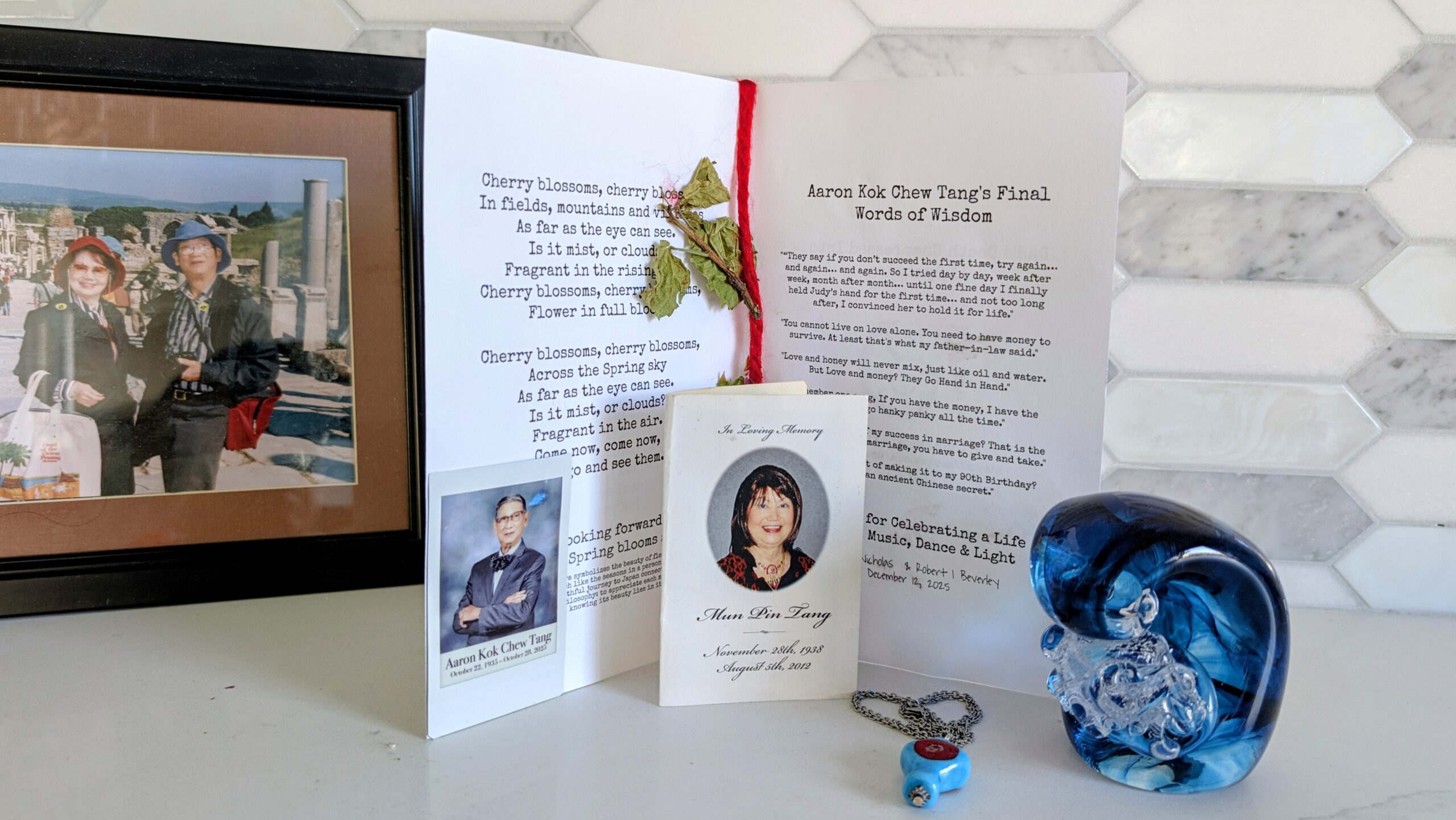
Recently, I have also found myself reflecting on two small memorial objects that now contain some of Mom’s and Dad’s ashes.
One is a turquoise stupa necklace with a red centre containing two figures resembling the number eight. In Chinese culture, eight is often associated with good fortune and prosperity, and the repetition of the number can carry an added sense of auspiciousness. For me, the two eights have also come to represent Mom and Dad, their marriage, and the lives they shared.
What I find particularly interesting is that the two figures are not identical. Dad’s eight, on the right, appears more clearly formed, while Mom’s, on the left, is less regular. The irony makes me smile because, in life, Dad was often the messier one, while Mom was generally more organized.
I don’t imagine that the shapes somehow reveal their personalities or were created to convey a hidden message. But knowing them as I did, I cannot help seeing something personal in the contrast. It is a small, unexpected reminder of how we recognize meaning through our memories and relationships.
The other memorial is a blue glass sculpture shaped like a wave, with a smaller, lighter wave emerging within it. Some of Mom’s and Dad’s ashes have been incorporated into the sculpture, giving it a physical connection to both of them.
I find myself drawn to the movement suggested by the glass. A wave has a recognizable form, yet it is also something we associate with change, motion, and continuity. The sculpture is physically still, but its shape reminds me of movement. It brings together memories of two people whose lives were intertwined and whose influence continues in ways that matter to me.
In one sense, these memorials are simply physical objects containing material remains. In another, they carry memories, emotions, and relationships that cannot be measured by their physical composition alone. And intellectually, they invite me to think about form, change, continuity, and the meanings we attach to patterns.
I can appreciate all of these perspectives without assuming that one proves the others. A pattern can be meaningful to us without necessarily revealing a universal law.
I sometimes wonder what Dad would have thought about artificial intelligence and my unexpected research adventure. Given his curiosity about technology and magic, I suspect he would have been fascinated, and perhaps amused that I had become so absorbed in exploring these questions.
I also think about Mom, her prayers, her stories, her love of music and dancing, and the questions she struggled with during her illness. And I remember my grandmother’s unusual story from so many years ago, which I still cannot explain but have never forgotten.
As I prepare to share these reflections on November 18, 2026, I am reminded that this is also Mom and Dad’s wedding anniversary. I hadn’t originally set out to connect the anniversary with this research journey, but there is something meaningful about remembering them together on a day that marked the beginning of their life as a married couple.
Perhaps it is another example of the patterns and connections I have become increasingly curious about. Did I discover the significance of this date, or did knowing their anniversary influence the meaning I now attach to it? I don’t know that there needs to be a definitive answer. What matters to me is that, on this particular day, I find myself thinking about both of them and how much of their lives continues to shape my own.
What is life? What is consciousness? What happens when we die? I still don’t know, and perhaps I never will. But I no longer feel that I must choose between curiosity about spirituality and a commitment to logic. I can respect the faith and traditions of my family, remain open to life’s mysteries, and still question the evidence.
I can find meaning in an experience without claiming that I have explained its cause.
Looking back, I find it remarkable that a year which began with such personal loss could also become a year of unexpected intellectual discovery.
Sixteen papers, a lifetime of questions, and a journey I never imagined beginning. The curiosity had been with me for years, but it was Dad’s passing that finally brought so many of those questions to the surface.
For Dad and Mom, with love and gratitude.