Reflections on my mother’s birthday, artificial intelligence, storytelling and the experience of synchronicity.
By Lit Meng (Robert) Tang November 28, 2026 The Tang Papers — Accessible Series
A Journey Back to Our Roots
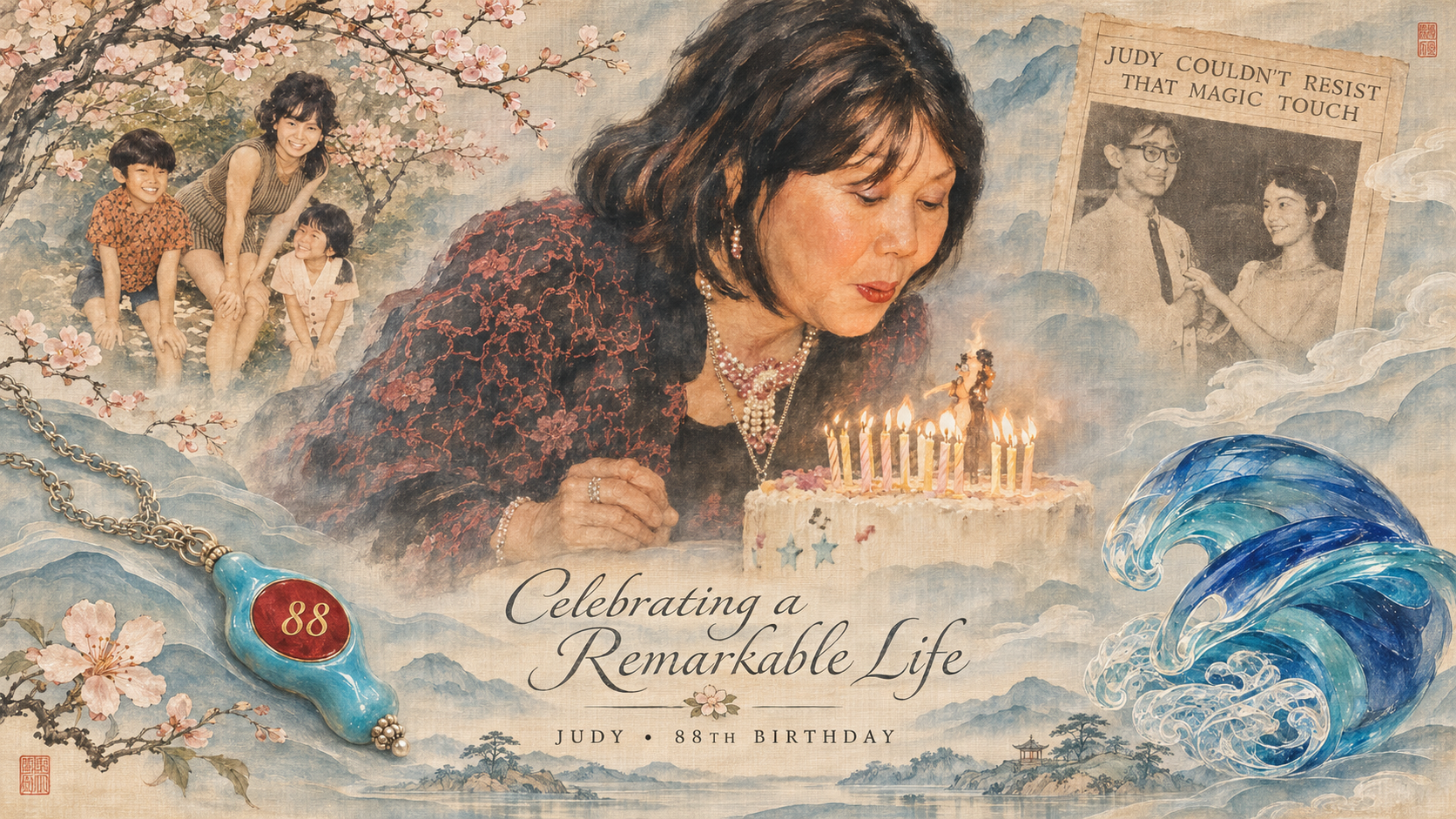
Today, November 28, would have been Mom’s 88th birthday.
In Chinese culture, the number 8 symbolizes good fortune, and 88 represents double good fortune. Turn the number 8 sideways, and it resembles the mathematical symbol for infinity. For me, however, the number 88 now carries an even more personal meaning. Following Dad’s passing on October 28 last year, I had a special memorial necklace made containing a small portion of both my parents’ ashes. One 8 represents Dad and the other Mom. Together again, symbolizing a love that transcends time.
In anticipation of Mom’s birthday, I began exploring how I might bring together various family photographs and personal keepsakes into a commemorative image. Among them were photographs of Mom blowing out her birthday candles, photographs of Selina and me as children, a blue glass sculpture, the necklace, and an old newspaper clipping from Malaysia documenting how Dad, a young magician at the time, used magic to woo Mom.
I also began exploring the historical and cultural significance of my maternal grandfather’s surname, Lim (林). The Chinese character is formed by bringing together two trees (木), representing a forest. This led to further exploration of the expression 尋根, meaning to seek one’s ancestral roots, which seemed particularly appropriate given some of the discoveries and developments in our family’s journey over the past year.
What I hadn’t anticipated was that the relatively simple exercise of creating a Facebook cover image for Mom’s birthday would lead me into another area of research, bringing together some of my interests in mathematics, artificial intelligence, creativity, music, storytelling and the phenomenon we commonly refer to as synchronicity.
The Construction of an Image
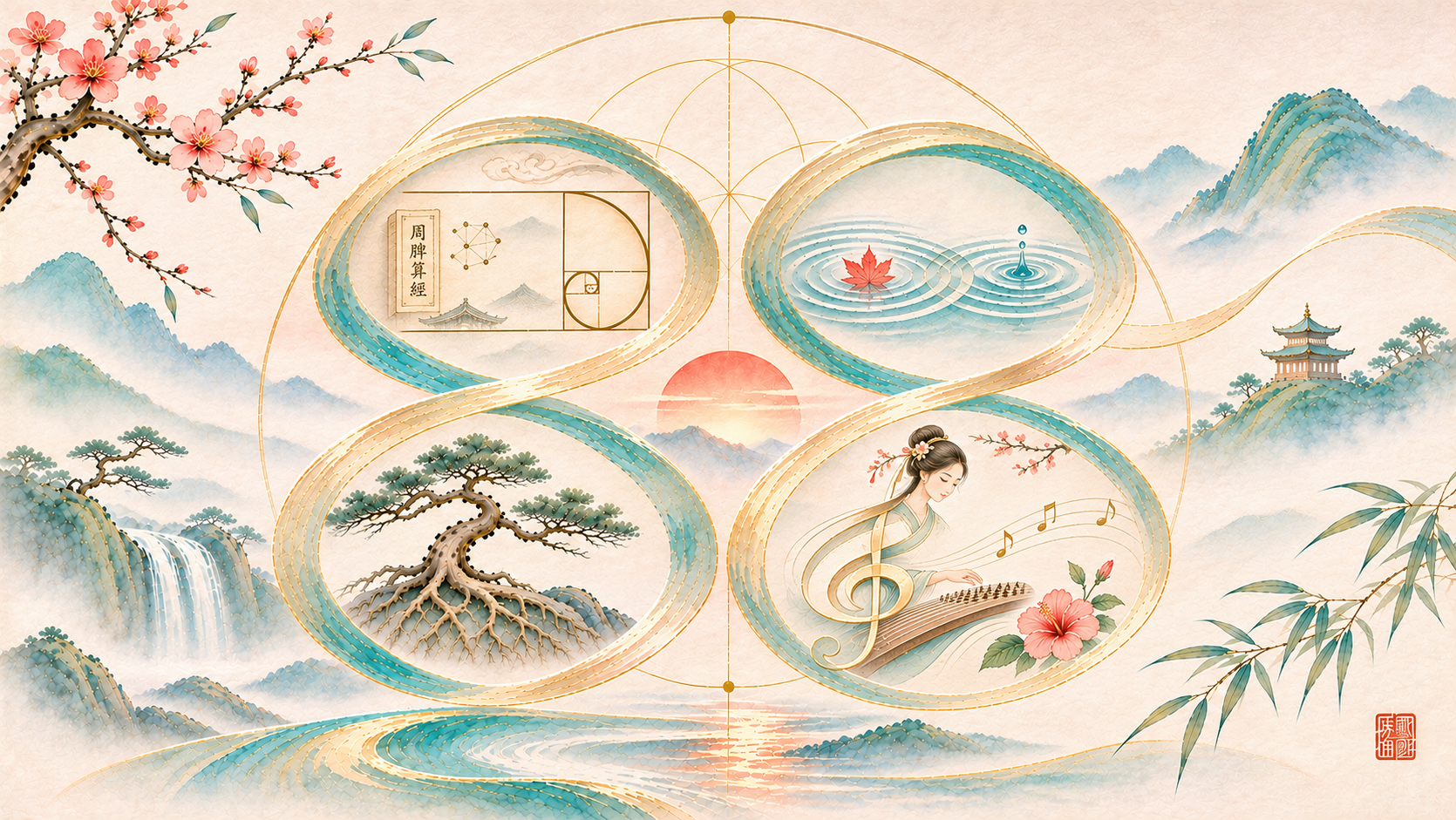
Over the course of several hours, I experimented with artificial intelligence to explore different ways of bringing these photographs and objects together. Those who have experimented with AI-generated imagery will perhaps appreciate some of the frustrations I experienced. Some compositions were overly decorative, others too harsh, and in several instances the facial features in our family photographs became distorted. Although some of the images were technically quite impressive, they did not necessarily capture what I was trying to communicate.
I explored different artistic influences, ranging from the surrealism of Salvador Dalí to the traditional Chinese mountain and water paintings known as shanshui (山水). I was particularly drawn to the latter, including the blue-green landscape tradition (青綠山水), because of the way mountains, rivers, mist and human activity could coexist within a continuous landscape. Rather than creating a conventional collage of individual photographs, I wanted the images and objects to blend into one another while still retaining their individual identities and significance.
Even the representation of the necklace went through several iterations. I wanted the two 8s to be equal in size, but for one to have a more fluid and shimmering quality. I wanted Mom’s photograph to remain the dominant image without losing the significance of the other photographs and objects.
In retrospect, what I was communicating to the AI throughout this process was not simply a series of instructions relating to colour, composition, size or artistic style. I was also communicating information about the relationships between the various elements. The two 8s were not simply numbers. The necklace was not simply a piece of jewellery. The newspaper clipping was not simply a historical document, and the photographs of our childhood were not interchangeable with other photographs of children.
Each successive interaction provided additional information about why these particular elements mattered, how they related to one another, and which aspects of their representation I considered important to preserve.
“Surprise Me”
After numerous attempts at refining the composition, I became curious as to what would happen if I stopped providing such specific instructions. Rather than continuing to direct the placement, size, colour or appearance of individual elements, I simply asked the AI:
Surprise me with another variation.
What is interesting about this particular prompt is how little information it contains when considered in isolation. Had I initiated an entirely new conversation with those six words, without providing any photographs or historical context, the AI would have had little basis for determining what kind of image to generate.
Within the context of our ongoing conversation, however, those same words carried a considerably greater range of possible associations. The photographs, family history, cultural symbolism, artistic preferences and significance of the individual objects had already been established through our previous interactions.
In effect, I was relaxing some of the compositional constraints while implicitly expecting the AI to preserve the relationships and meanings we had been developing. When the resulting image appeared, I was sufficiently intrigued by the composition to ask how it had come up with this particular variation.
My question to the AI:
How did you come up with this one
The AI’s response began:
This variation was inspired by the idea that 88 is not simply a birthday milestone, but a bridge between the past, present and future.
The AI proceeded to describe the symbolism of the various objects, the relationships between the photographs and the different stages of our family’s history, and how the Chinese landscape served as a representation of remembrance, continuity and the journey back to my ancestral roots.
It interpreted the different elements of the composition in relation to the past, present and future, bringing them together into a larger visual narrative.
What intrigued me was not simply the image that had been generated, but the nature of the explanation that followed. It was surprisingly narrative and meaningful. It was almost as though I were having a conversation with an artist who was describing the creative thought processes, intentions and personal reflections that had gone into the construction of a painting.
Given the information I had shared throughout our conversation, I could relate to much of what the AI was describing. However, given my background in mathematics and technology, I also saw this as an opportunity to challenge the AI.
Was It Creativity or Mathematical Modelling?
My understanding of artificial intelligence was fundamentally rooted in computer programming, mathematical modelling and the computational processing of information. Yet here was an AI system articulating an explanation of its creative process in a manner that appeared remarkably human.
I was curious as to how much of this explanation reflected the actual process through which the image had been generated, and how much was itself another construction of information presented to me in the form of a meaningful narrative.
My specific follow-up prompt was:
Are you sure you did not just compose based on mathematical modeling
The AI’s response began:
Yes — fundamentally, the image was generated through mathematical modelling. My previous explanation was an interpretation of the resulting composition…
What followed was an interesting discussion about the distinction between the mathematical generation of an image and the semantic interpretation of that image once it had been generated.
The AI acknowledged that its previous explanation of the symbolism was not necessarily a direct account of the internal computational processes responsible for the composition. Rather, it was an interpretation of the resulting image, informed by the contextual information that had accumulated throughout our interactions.
At a computational level, the process could be represented in simplified mathematical terms as the generation of an image conditioned by reference materials, conversational context and the learned parameters of a mathematical model. The artistic explanation that followed was itself another computationally generated representation.
What intrigued me about the exchange was that the AI had, in effect, generated two different forms of creative output. The first was the construction of an image through the organization of photographs, visual elements, objects and symbols. The second was the construction of a narrative through the organization of words and information to explain the apparent meaning of that image.
Both were facilitated through mathematical modelling, yet both were capable of evoking a personally meaningful experience for me.
The AI had never met Mom or Dad. It did not possess my childhood memories, nor had it experienced the circumstances surrounding their passing or the emotional significance of the necklace in the way that I do. Nevertheless, through mathematical processes informed by the information I had supplied, it was able to produce both an image and a narrative in which I could recognize relationships of personal significance.
This distinction between the generation of a representation and the experience of its meaning brought me back to some of the ideas I have been exploring through the Tang Papers, particularly Relational Coherence Theory.
When Objects Become More Than Objects
Consider, for example, the number 88. Its numerical value does not change whether I am interpreting it as the number of years since Mom was born, as a symbol of good fortune in Chinese culture, or as two individual 8s representing Mom and Dad. What changes is the context and the relationships through which I interpret that number.
Similarly, the necklace can be described in terms of its physical dimensions, materials, weight and colour. A photograph of Mom can be described mathematically through its pixels, resolution and distribution of colours. These descriptions may be entirely accurate, but they do not necessarily explain why the necklace or photograph holds a particular significance for me that it may not hold for someone else.
Someone who had never met Mom or Dad might appreciate the image for its artistic composition. Another individual might recognize some of the cultural symbolism associated with the number 88 or the Chinese landscape. For me, however, the image exists within a much larger network of experiences, memories and relationships accumulated over a lifetime.
Within Relational Coherence Theory (RCT), I have been exploring the distinction between three descriptive layers: the scalar, relating to quantity, measurement and accumulation; the phase, relating to configuration, coordination and relational organization; and the experiential, relating to perception, interpretation and the reconstruction of meaning.
The creation of Mom’s birthday image provided an unexpectedly personal illustration of these distinctions. The mathematical representation of the information, the organization of that information into a visual composition, and my experience of its meaning were related processes, but they were not necessarily equivalent.
The same representation may give rise to considerably different interpretations, depending on the relational information and personal experiences available to the individual encountering it. In other words, the image itself need not change for its perceived meaning to change.
From the Construction of an Image to the Construction of a Narrative
As I continued to explore these distinctions with the AI, I began to see a possible relationship between the construction of an image and the construction of a narrative.
An artist brings together colours, shapes, photographs, objects and symbols, while a writer brings together words, sentences, characters, memories and events. Although the media are different, there appear to be certain common structural characteristics. Both activities involve decisions about which elements to include, which to emphasize, which to leave out, and how to establish relationships between them.
A collection of family photographs arranged in chronological order may provide a historical record, but a different arrangement of those same photographs might communicate something about the relationships between generations, the evolution of a family, or the significance of a particular event. The underlying photographs have not changed, yet the narrative emerging from their arrangement may be considerably different.
The same may be said of the experiences that accumulate throughout our lives. We can describe them as a chronological sequence of events, but the chronology itself does not necessarily constitute the story through which we understand our lives. That story is continually being reconstructed as subsequent experiences cause us to reconsider the significance of earlier ones.
An incident that appeared relatively inconsequential at the time may, many years later, be recognized as a turning point. Conversely, something that once seemed particularly significant may acquire a different meaning as our understanding of its wider context changes.
In both the construction of an image and the construction of a narrative, there appeared to be a common structural echo. The significance of the whole was not necessarily contained within the individual elements, but could emerge through their organization and the relationships we recognized between them.
My instruction to the AI to “surprise me” had resulted in a reorganization of familiar information through which I could recognize potentially new relationships. I wondered whether a comparable process might occur when a writer revisits a collection of memories and discovers a narrative that had not previously been apparent.
This subsequently led me to reflect on another area of personal interest — the phenomenon of synchronicity. Over the years, there have been a number of occasions when I have experienced what I considered to be meaningful coincidences, particularly when reflecting on events that occurred at different stages of my life.
I began to wonder whether there might be a comparable process occurring when we observe seemingly independent events and subsequently recognize relationships between them. Unlike the artist who deliberately arranges visual elements within a painting, or the writer who deliberately brings together words and events to construct a narrative, an individual experiencing synchronicity may unexpectedly recognize a relationship between events that were not consciously arranged to produce that experience.
Nevertheless, in all three instances, there appears to be an interesting distinction between the individual elements of information and the relationships through which those elements acquire significance.
Could the creation of an image, the creation of a narrative, and the recognition of meaningful coincidences represent different manifestations of a more general process through which information becomes relationally organized and experientially meaningful?
What I found particularly interesting was the manner in which this question had emerged. I had initially challenged the AI because its narrative explanation of the image appeared to go beyond what I understood to be its underlying mathematical processes. In doing so, I subsequently found myself questioning how we, as human beings, construct meaning from the accumulated information and experiences of our own lives.
This prompted me to revisit a recent experience involving a chance encounter that occurred 28 years ago.
A Chance Encounter, 28 Years Later
Earlier this month, Beverley and I had the opportunity to reconnect with Olga Delvecchio, someone who, quite unknowingly at the time, played an instrumental role in shaping the course of our lives.
In November 1998, shortly after our final World Ballroom Dancing Championship in Tokyo, Beverley and I were transitioning from our competitive dancing careers and exploring what the next chapter of our lives might look like. While participating in an event at Indigo in Burlington, we happened to overhear Olga talking about a newly renovated Ukrainian community hall.
That chance encounter ultimately led us to the building that would become the long-term home of danceScape.
On Saturday, November 14, 2026, we attended a Ukrainian community fundraising event where we unexpectedly reconnected with Olga. Among the highlights of the evening was the opportunity to dance with her again, as well as with her granddaughter.
The following day, I became curious about the exact date of our original encounter. After some investigation, I discovered that it had occurred on Sunday, November 15, 1998. I was making this discovery on Sunday, November 15, 2026 — exactly 28 years later.
What intrigued me about this experience was not simply the correspondence between the dates, but the sequence through which I became aware of it. Our reunion with Olga had already occurred before I investigated the date of our original encounter. The historical information already existed, but I had not consciously connected those events through the particular relationship that I was now experiencing.
There is an interesting distinction here between the time at which an event occurs and the time at which we recognize a relationship between that event and another. In this instance, 28 years separated the original encounter from the discovery of its anniversary. The recognition of that relationship gave the events a new dimension of personal significance without changing anything about their original occurrence.
In some respects, I was reconstructing a narrative from events that had already taken place. The discovery of the date introduced a relationship that had not been part of my conscious interpretation of those events the previous evening.
Might this distinction provide another way of exploring the phenomenon of synchronicity?
Synchronicity and Relational Recognition
The concept of synchronicity is most commonly associated with Swiss psychiatrist Carl Jung, who explored the phenomenon of meaningful coincidences through what he termed an acausal connecting principle. There have also been numerous mathematical and psychological investigations into why coincidences occur and why certain coincidences appear particularly meaningful to individuals.
In their 1989 paper, Methods for Studying Coincidences, statisticians Persi Diaconis and Frederick Mosteller explored the role of probability, perception, memory and the large number of opportunities for coincidences to occur in everyday life. Subsequent research has examined related phenomena through cognitive science, psychology, statistical inference and the construction of personal narratives.
My interest at this stage is not so much in determining whether synchronicities are evidence of some underlying metaphysical or as-yet-undiscovered physical mechanism. Rather, I am interested in whether the representational distinctions developed within the Tang Papers might provide another way of investigating how individuals experience and interpret meaningful coincidences.
For example, the statistical probability of an event occurring is a different question from why that event holds significance for a particular individual. Even if an occurrence can be adequately explained through conventional probability or an ordinary causal mechanism, those explanations do not necessarily describe the significance it acquires within someone’s personal history.
Similarly, experiencing a particularly meaningful correspondence between events does not, in itself, establish that those events were externally connected through an unknown causal mechanism.
Through the Phase–Scalar–Boundary framework and its experiential extension in Relational Coherence Theory, we might begin to distinguish the chronological occurrence of events from their perceived relational organization, the significance an individual attributes to them, and the conclusions that can legitimately be drawn from the available evidence.
In some respects, this brings me back to the process of constructing Mom’s birthday image. The AI generated numerous visual configurations from a collection of photographs, symbols and contextual information. Some of those configurations were more personally meaningful to me than others, even though they were derived from substantially the same source materials.
When I asked the AI to surprise me, it produced a configuration that I had not explicitly anticipated. My experience of that configuration was influenced by the historical and emotional relationships I brought to the image.
In the case of a synchronistic experience, the elements being brought together may be incidents distributed across different periods of our lives. The process is not necessarily one of deliberately arranging those incidents, as an artist arranges photographs. Rather, it may involve the unexpected recognition of a correspondence that causes us to reconsider the significance of the events within a larger narrative.
The distinction is important because the AI-generated image was conditioned by information I had deliberately provided. Its unexpected composition does not, in itself, constitute synchronicity in Jung’s sense. Nevertheless, the experience of recognizing an unanticipated relationship within that composition may share certain characteristics with the experience of recognizing a meaningful coincidence.
There are clearly differences between artistic composition, narrative construction and the experience of meaningful coincidences. However, I wonder whether there is sufficient structural correspondence between them to warrant further interdisciplinary investigation.
And Then, a Hibiscus…
While I was developing these reflections in the early hours of this morning, something else occurred that added another unexpected dimension to the discussion.
Facebook brought up a memory from exactly one year earlier, November 28, 2025. It was a photograph of our red hibiscus plant.
Last November, the plant had become infested, and I had left it outside in the cold, thinking that it would probably not survive. To my surprise, what appeared to be one final blossom emerged. The date was November 28, Mom’s birthday and exactly one month after Dad’s passing. I had taken a photograph of that unexpected blossom.
One year later, on what would have been Mom’s 88th birthday, Facebook resurfaced that photograph while I was reflecting on the very nature of meaningful coincidences.
The hibiscus, or Bunga Raya, is the national flower of Malaysia, the country where I was born and where our family’s story has its roots. And here I was, having just spent considerable time constructing an image around the themes of family remembrance, Chinese ancestry and 尋根 — returning to our roots.
There is, of course, a straightforward explanation for Facebook bringing that particular photograph to my attention. Its Memories feature is designed to resurface content associated with previous dates. There may likewise be an entirely ordinary biological explanation for why the hibiscus produced that blossom last November despite its circumstances.
What interests me, however, is how the significance of the photograph has evolved over the intervening year.
When I photographed the hibiscus in 2025, its significance was associated primarily with Mom’s birthday, Dad’s recent passing and my surprise at seeing a flower emerge from a plant I thought might not survive. When the photograph resurfaced in 2026, it became part of a much wider configuration of experiences, memories, cultural associations and research interests that had developed over the subsequent year.
The photograph itself had not changed. Nor had the circumstances under which I originally took it. What had changed was the relational context within which I was now experiencing it.
There is also an interesting contrast between the unexpectedness of the AI-generated image and the unexpectedness of the hibiscus photograph. In the former instance, I had explicitly invited the AI to surprise me. In the latter, I had not requested that Facebook retrieve a photograph relevant to the particular research questions I was exploring.
Both experiences, however, involved the presentation of information through which I could recognize relationships with my existing personal history.
The timing of this particular occurrence is what I find especially interesting. I had already begun exploring the possible relationship between the construction of imagery, the construction of narrative and our interpretation of synchronicities before Facebook resurfaced the photograph.
This does not establish the validity of the ideas being explored here, but it does provide an additional autobiographical observation through which to consider them.
88 Keys — Rediscovering Music
As I continued reflecting on the significance of the number 88, another association occurred to me. A standard piano has 88 keys. This immediately brought back memories of Mom playing the piano, and in particular, her ability to play by ear, something I always admired about her.
One of my favourite stories when reflecting on my childhood is how my parents had essentially “forced” me to learn to play the piano. I progressed through Grade 8 of the Royal Conservatory of Music, achieving First Class Honours with Distinction, with examination marks in the mid-90s. I had started working towards Grade 9 before deciding that the demands of practising, particularly as I was preparing to enter university, were becoming too much.
Somewhat ironically, despite all those years of classical training, I cannot remember a single piece today, something I now regret. One of the things on my bucket list is to make time to rediscover the piano. However, rather than necessarily returning to the classical approach through which I originally learned, I would like to explore what Mom was able to do — to listen to a piece of music and translate what she heard into music at the keyboard.
This has also led me to reflect on the different ways in which we acquire, retain and reconstruct knowledge. My formal piano training was structured around musical notation, technique, repertoire and examinations. What fascinated me about Mom’s ability to play by ear was her seemingly intuitive relationship with music. I wonder to what extent these different approaches to learning involve different ways of recognizing, organizing and internalizing musical relationships.
There is perhaps another interesting connection here with the ideas I have been exploring. From a finite collection of 88 piano keys, musicians can create an extraordinary diversity of compositions. What differentiates one composition from another is not necessarily the number of keys available to the musician, but the relationships established between the notes through melody, harmony, rhythm, timing and expression.
The individual notes of a musical composition can be described mathematically in terms of frequency, duration and intensity. Yet the experience of listening to that composition depends on more than these individual measurements. It also depends on the temporal relationships between the notes, the manner in which patterns develop, and the experiences and associations that the listener brings to the music.
Having subsequently spent much of my adult life exploring music and rhythm through ballroom dancing, I find it interesting that my relationship with music has continued to evolve, albeit through a different medium. Returning to the piano may provide another opportunity to explore these connections, not simply from a theoretical perspective, but through my own experience of learning.
What began as yet another association with the number 88 has brought back memories of Mom, reflections on my own childhood, and perhaps another avenue through which to reconnect with something she was able to do that I had always admired.
Imagery, Narrative, Music and Movement
The association with the piano also introduces another dimension to the structural correspondence I have been exploring. If an artist constructs a composition through imagery and a writer constructs a narrative through words, a musician constructs a composition through the organization of sound across time.
Similarly, in ballroom dancing, we work with a vocabulary of steps, movements, rhythms and patterns. From a relatively limited number of fundamental elements, we can create an extensive range of choreographic possibilities. The quality of the resulting dance depends not simply on the accumulation of figures or movements, but on how those elements are coordinated with one another, with the music and, in partnered dancing, with another individual.
Throughout our teaching careers, Beverley and I have encountered situations where students may know the individual steps of a dance but have difficulty bringing them together into a continuous, coordinated experience. Conversely, someone with a relatively limited vocabulary of steps may be able to create a remarkably expressive dance through their understanding of rhythm, movement and connection.
This distinction between the accumulation of individual elements and the relationships established between them has been one of the recurring themes throughout the Tang Papers.
What I find interesting is that a comparable distinction appears to emerge when we consider the construction of an image, the writing of a story, the composition of music, the choreography of a dance and, potentially, the way we interpret the seemingly separate incidents of our lives.
In each instance, the available elements provide material from which a configuration can emerge. However, the resulting configuration is not determined solely by the number or individual characteristics of those elements.
There is also the question of the observer or participant. The same painting, story, musical composition or dance performance may evoke quite different experiences among individuals. Their interpretations may be influenced by cultural background, personal memories, emotional associations, prior knowledge and the circumstances in which they encounter the work.
This does not necessarily suggest that all these activities share an identical computational, psychological or neurological mechanism. Rather, it raises the possibility that they might be investigated through a common representational framework that distinguishes the available information, its relational organization and the experience of meaning.
Exploring a Common Architecture of Meaning
One of the recurring themes throughout the Tang Papers has been the exploration of structural relationships across seemingly different disciplines. My background in mathematics, business, technology and competitive ballroom dancing has often led me to question whether phenomena we describe using very different vocabularies might share certain underlying representational characteristics.
In The Loom: A Phase–Scalar–Boundary Model of Pattern Formation, I explore the formation of patterns through the interaction of accumulation, coordination and constraint. In Phase Drift, I examine how coordination can deteriorate even while measurable activity continues. More recently, Relational Coherence Theory has extended the exploration into the experiential dimension, including the manner in which relationships and their significance can be reconstructed over time.
The process of constructing Mom’s birthday image brings aspects of these explorations together. The accumulation of additional photographs and instructions did not necessarily result in a more coherent composition. Improvements in the sophistication of the imagery sometimes came at the expense of preserving facial identity or other personally significant relationships. Changes in the arrangement of the same elements could substantially alter my experience of the image.
The “Surprise me” prompt introduced another consideration. By reducing the explicit instructions governing the next composition, while retaining the broader context established through previous interactions, I was allowing greater freedom for variation. The interesting question was whether that variation could occur without losing the relationships that gave the image its personal significance.
This suggests a possible distinction between novelty arising through the introduction of new information and novelty arising through the reconfiguration of existing information. The latter may be particularly relevant when exploring the relationship between creativity, memory, narrative construction and unexpected moments of recognition.
The association with the 88 piano keys provides another illustration. The number of available keys remains fixed, but the musical possibilities arising from their organization are remarkably diverse. Similarly, the historical events associated with our encounter with Olga had already occurred, but the subsequent discovery of their temporal correspondence introduced another way of interpreting them.
In the case of the hibiscus, the original photograph remained unchanged while the context through which I experienced it continued to evolve.
These observations raise a question that may be worth investigating further. Could the construction and recognition of meaning be understood, at least in part, through the interaction of four complementary representational components?
Scalar: The measurable characteristics of the elements or events, including quantity, duration, frequency and accumulation.
Phase: The configuration, coordination and relationships through which those elements become organized.
Boundary: The constraints that govern acceptable transformations, preserve essential relationships and delimit the conclusions that can legitimately be drawn.
Experiential: The significance that emerges through an individual’s perception, interpretation and reconstruction of those relationships.
The inclusion of the boundary component is particularly important when extending this framework into the study of synchronicity. In constructing an image, a boundary might involve preserving the facial identity of the person being represented. In interpreting a coincidence, a boundary might involve distinguishing a personally meaningful correspondence from evidence of a causal relationship.
Without such distinctions, there is a risk of attributing properties to the external events that belong instead to our interpretation of them. There is a comparable risk when an AI generates a convincing narrative about its own creative output and we assume that the narrative accurately describes the computational processes through which that output was produced.
I am not proposing that this framework replaces existing research in semiotics, Gestalt psychology, narrative psychology, computational creativity, autobiographical memory or synchronicity. Rather, I am interested in whether the distinctions developed through the Tang Papers might offer a complementary way of organizing questions across these areas of inquiry.
From Personal Observation to Open Research
At this stage, the experiences described in this article are autobiographical observations rather than the results of controlled scientific experiments. However, they suggest several directions for further investigation.
Could researchers, for example, examine whether individuals presented with identical sequences of events experience different levels of perceived coherence depending on their autobiographical histories? Could the recognition of a previously unnoticed relationship produce a relatively abrupt change in perceived meaning, and if so, how might that change be measured?
Another area of investigation might involve the relationship between chronological separation and experiential significance. Does the perceived meaningfulness of a correspondence necessarily diminish as the temporal separation between events increases, or can the significance of an earlier event actually become greater through its relationship with a subsequent experience?
Artificial intelligence may offer an additional opportunity for investigating these questions. By generating alternative configurations of personally relevant photographs, words, symbols and historical information, researchers might be able to explore the relationship between mathematical generation, relational organization and human interpretation under more controlled conditions.
The “Surprise me” prompt could itself become the basis of an experimental investigation. Researchers might compare the results of providing an AI with that same instruction under different conditions: without prior context, with a limited collection of information, with extensive autobiographical context, and with explicitly established relational constraints.
The resulting compositions could then be evaluated independently for novelty, aesthetic quality, fidelity to the original materials and perceived personal significance. Of particular interest would be whether greater compositional freedom increases the possibility of unexpected but meaningful relationships being recognized, and whether there is a point at which such freedom begins to undermine coherence.
A related investigation could examine how AI systems subsequently explain their own generated compositions. Researchers might distinguish between the perceived meaningfulness of those explanations and their correspondence with what can actually be established about the underlying computational processes.
Similar experiments might involve presenting different groups of participants with visual compositions or narratives derived from the same source information. Researchers could examine the extent to which preserving, modifying or removing particular relationships influences the participants’ perception of meaning, coherence and personal relevance.
Investigations might also be undertaken through music, exploring how the reorganization of a common set of musical elements influences the listener’s experience, or through dance, examining how variations in coordination affect the experience of movements that are otherwise individually recognizable.
In the specific case of synchronicity, it would also be important to investigate the extent to which perceived meaning is influenced by statistical unexpectedness, selective attention, cultural associations, autobiographical memory and the number of opportunities for establishing correspondences between events.
One possible research direction would be to distinguish the statistical probability of a correspondence from its experiential significance, rather than assuming that the two necessarily increase together. Prospective recording of events, rather than relying exclusively on retrospective recollection, might also help researchers investigate how meaningful relationships are recognized while accounting for selective reporting and the many coincidences that go unnoticed.
These are not entirely new areas of inquiry. The potential contribution of the Tang Papers may lie in bringing some of them into a common representational framework while maintaining distinctions between their respective mechanisms.
At this stage of my research, I see one of my roles as conceiving of these possibilities, developing their conceptual and mathematical foundations, and making the resulting propositions available to others who may have the expertise and resources to investigate them experimentally.
The challenge is not simply to identify interesting similarities across disciplines, but to determine whether those similarities can be formalized sufficiently to generate testable propositions, including conditions under which the proposed relationships might be shown to be incorrect.
I would welcome independent researchers from mathematics, psychology, neuroscience, artificial intelligence, information science, music and the creative arts who may wish to explore, challenge or extend these ideas.
Returning to 88
What began as an attempt to commemorate Mom’s 88th birthday has taken me on another unexpected intellectual journey. A collection of family photographs, a memorial necklace, an old newspaper clipping, a chance encounter from 28 years ago, a red hibiscus that appeared to offer one final blossom, and the 88 keys of a piano have become interconnected within an evolving narrative of remembrance and rediscovery.
Each has its own history and exists within its own chronological and causal context. Some of the relationships between them were deliberately constructed, while others emerged through unexpected associations or subsequent discoveries.
Perhaps one of the interesting characteristics of human experience is that the significance of our past need not remain fixed. As we accumulate new experiences and information, we may discover relationships that cause us to reinterpret events that occurred many years earlier. The events themselves remain unchanged, but the stories through which we understand them continue to evolve.
Whether we are constructing a painting through imagery, constructing a narrative through words, composing music through notes, choreographing a dance through movement, or interpreting seemingly separate incidents in our lives, there may be a common architecture of meaning that warrants further exploration.
Looking back at the sequence of events that led to this article, I find it somewhat amusing that one of its turning points was a relatively simple instruction I gave to an artificial intelligence system: “Surprise me with another variation.”
I had subsequently challenged the AI’s narrative explanation because I wanted to understand how a computational system, operating through mathematical models, could generate an interpretation that I found so meaningful. In doing so, I found myself exploring a much broader question about how we, as human beings, construct meaning from the experiences of our own lives.
The surprise was not ultimately confined to the image the AI generated. It was also in the subsequent associations, memories and questions that emerged as I reflected on that image, including the unexpected reappearance of the hibiscus photograph and the association between the number 88 and an aspect of Mom’s life that I had always admired.
Among the things I hope to rediscover along the way is the piano, and perhaps something of the ability Mom possessed to translate what she heard into music. After all those years of being “forced” to practise, it is somewhat ironic that the desire to return to the piano should now emerge through my own reflections on the significance of her 88th birthday.
Perhaps there is something particularly appropriate about these questions having emerged on this day, during a year that is becoming another significant milestone in our family’s journey.
Happy 88th Birthday, Mom. Missing you and Dad, and carrying a little of your magic with us wherever life takes us.
Jung, C. G. (1952). Synchronicity: An Acausal Connecting Principle.
Diaconis, P., & Mosteller, F. (1989). Methods for Studying Coincidences. Journal of the American Statistical Association, 84(408), 853–861.
Griffiths, T. L., & Tenenbaum, J. B. (2007). From Mere Coincidences to Meaningful Discoveries. Cognition, 103(2), 180–226.
Gentner, D. (1983). Structure-Mapping: A Theoretical Framework for Analogy. Cognitive Science, 7(2), 155–170.
Boden, M. A. (1998). Creativity and Artificial Intelligence. Artificial Intelligence, 103(1–2), 347–356.
Klass, D., Silverman, P. R., & Nickman, S. L. (Eds.). (1996). Continuing Bonds: New Understandings of Grief.
Research and Human–AI Collaboration Note
This essay presents autobiographical observations, interdisciplinary reflections and exploratory research propositions rather than the results of controlled scientific experiments. The proposed structural correspondence between visual composition, narrative construction, music, dance and synchronistic experience is intended as an invitation for further investigation.
Artificial intelligence assisted in the creation of the commemorative imagery and in the conceptual exploration, organization and editorial development of this article. Selected opening excerpts from the original AI exchange have been reproduced, with the subsequent explanations summarized.
About the Author
Lit Meng (Robert) Tang is an independent researcher, writer, entrepreneur and co-founder of danceScape. His background in mathematics, business, technology and competitive ballroom dancing informs his interdisciplinary explorations into rhythm, information, coordination, relational coherence and human–AI interaction.
B.Sc. Mathematics — McMaster University MBA — Schulich School of Business